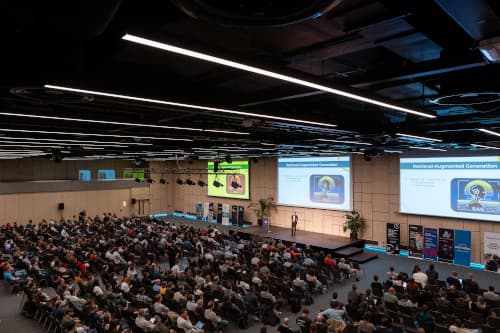
The 11th international conference on Machine Learning and Artificial Intelligence applications,
taking place in person in Prague and online.

Machine Learning Prague 2026

, 2026

Registration

World class expertise and practical content packed in 3 days!

You can look forward to an excellent lineup of 45 international experts in ML and AI business and academic applications at ML Prague 2026. They will present advanced practical talks, hands-on workshops, and other forms of interactive content to you.

What to expect

  • 1000+ Attendees
  • 3 Days
  • 45 Speakers
  • 10 Workshops

Phenomenal Confirmed speakers

Practical & Inspiring Program

Friday
Workshops

O2 Universum, Českomoravská 2345/17a, 190 00, Praha (workshops won't be streamed)

Registration from 8:00

Room D2 Room D3 Room D4 Room D6 Room D7
coffee break

Graph-Based Anomaly Detection: Methods and Hands-On Implementation

Room D2

Adam Jurčík, Seznam.cz
Jakub Chynoradský, Seznam.cz
Jaroslav Kuchař, Seznam.cz

This workshop introduces participants to the fundamentals and practical techniques of graph anomaly detection. Blending conceptual overviews with a hands-on lab the session teaches how to represent real-world systems as graphs engineer meaningful features and apply a range of detection methods to identify unusual nodes edges or communities. We will provide a concise overview of modern GAD methods categorized into the following families: Traditional Methods Embedding-Based Methods and Graph Neural Network (GNN).

Train a Small Language Model with SageMaker HyperPod

Room D3

Adir Gozlan, Amazon
Mayank Gupta, Amazon

In this highly practical workshop participants will experience end-to-end training of a small-scale language model using Amazon SageMaker HyperPod a cutting-edge distributed training environment purpose-built for large foundation models. With growing interest in domain-specific and lightweight LLMs this session will bridge the gap between theoretical knowledge and applied training workflows on modern cloud infrastructure. Participants will leave with a reproducible cloud-native setup and hands-on familiarity with distributed LLM training — from resource allocation to performance tuning. We will emphasize how to make small models perform competitively using techniques like LoRA quantization and mixed-precision training.

Probabilities Over Prompts: How to Stop Begging and Start Modeling

Room D4

Ludek Matyska, Rouvy
Vojtech Kadlec, STRV

Modern interaction with large language models often ends with a plea: “please don’t hallucinate.” This workshop revisits the foundations of machine learning and shows how they remain essential in the era of generative AI. Participants will learn to work with the probabilistic structure that LLMs expose using token-level log probabilities to build classifiers evaluate uncertainty and detect hallucinations. Through practical examples we demonstrate how classical ML techniques such as calibration fine-tuning and systematic testing can produce reliable verifiable outcomes. Rather than treating LLMs as black boxes to be prompted we treat them as probabilistic learners to be measured — because when a model hallucinates the answer is not to beg it but to calibrate and test it.

From Prediction to Impact: Machine Learning Meets Econometrics for Causal Inference in Organizations

Room D6

Nadzeya Laurentsyeva, Sanofi
Luděk Stehlík, Sanofi
Ivan Ushakov, Sanofi

This hands-on workshop shows how to draw credible causal insights when RCTs aren’t feasible. Using a people-analytics case on employee training - with both a staggered rollout and a voluntary global rollout - we walk through the full pipeline: design identification choice estimation and stakeholder communication. We cover Differences-in-Differences Instrumental Variables and Regression Discontinuity; build Directed Acyclic Graphs to formalize assumptions; and implement Generalized Estimating Equations Coarsened Exact Matching and Double Machine Learning. We also use Causal Forests to surface heterogeneous effects giving practitioners a robust end-to-end toolkit for impact evaluation in real organizational settings.

From Maps to Models: Hands-On Geospatial Data Processing for Data Scientists

Room D7

Filip Kojan, O2/Dataclair
Ondřej Karlíček, O2/Dataclair

This workshop offers a comprehensive introduction to geospatial data processing tailored for beginner and intermediate machine learning practitioners. Participants will explore essential concepts including spatial data types coordinate reference systems and projections as well as core operations for analyzing and manipulating geospatial information. You will see how geospatial data can be integrated into machine learning workflows through feature engineering and spatial analysis. Additionally visualization techniques will be covered to help interpret and communicate geospatial data.

Lunch
coffee break

Find the Bottleneck: Speed Up ML Pipelines by 10%–500%

Room D2

Michal Šustr, FEE CTU

Modern GPUs keep getting faster each generation enabling ever larger training and inference workloads. But in many real-world applications GPU compute is no longer the slowest part: I/O and data movement are. This workshop teaches a practical systematic approach to diagnosing and eliminating data-loading bottlenecks. Participants will learn how to design high-throughput data pipelines for both training and inference. By the end of the session attendees will be equipped with techniques that typically yield 10% to 500% pipeline speedups — often without touching the model architecture at all.

From Zero to Task-Master: Hands-On Fine-Tuning of Large Language Models for Specialized Applications

Room D3

Elad Ben-Zaken, Dream
Oded Ovadia, Dream

Large Language Models (LLMs) such as GPT Claude and Grok have transformed the landscape of AI but using them effectively for specific real-world tasks often requires more than prompt engineering. Fine-tuning task-specific adaptation and efficient training strategies are essential to unlock their full potential. This workshop is designed for advanced practitioners who want to go beyond using LLMs as generic assistants and learn how to systematically adapt them to rule a particular domain or task. Over the course of 3 hours participants will gain practical hands-on experience in training and adapting LLMs. Starting with a pre-trained foundation model we will walk through the full pipeline of dataset preparation fine-tuning evaluation and deployment. Attendees will bring their laptops and work along implementing techniques directly in code.

Building and Backtesting ML Investment Strategies

Room D4

Karolina Cynk, CERN

This workshop provides a technical walkthrough for constructing and evaluating machine learning – based investment strategies using fundamental financial data (information about a company’s performance e.g. revenue profits and debt). Drawing on my practical experience at the CERN Pension Fund we will cover the full development pipeline: data preprocessing signal generation and backtesting.

Beyond Single Decision: A Practical Tutorial on Slate Bandits

Room D6

Roman Dušek, Bloomreach
Nairit Banerjee, Bloomreach

This hands-on workshop is designed for machine learning practitioners and data scientists seeking to advance from single-item personalization to solving complex multi-slot decisions. While contextual bandits excel at selecting one optimal item modern digital platforms require the simultaneous optimization of entire "slates" of content. This session provides a comprehensive overview of the theory and practical application of slate bandit algorithms.

Recommender Systems in the Age of Generative AI

Room D7

Jan Kislinger, Sky Czech Republic

Generative AI has revolutionized content creation but what if we use it to generate the entire recommendation experience itself? In this workshop we explore how generative models can go beyond tagging or summarizing content to compose full recommendation pages. Participants will build prototypes that generate coherent page layouts using autoregressive models that attend to previously generated tiles. We will connect traditional recommenders with new generative methods to show how to move from ranking individual items to creating personalized experiences end to end.

Saturday,
Workshops

O2 Universum, Českomoravská 2345/17a, 190 00, Praha (and on-line)

Registration from 9:00

Welcome to ML Prague 2026

Inference in the Wild: Real Lessons on Scaling LLMs for Big Data

Shaul Cohen, Similarweb

Large language models are revolutionizing how we build intelligent systems, but deploying them on massive datasets in production brings serious challenges — from runtime bottlenecks and spiraling costs to maintaining output quality at scale. 
In this talk, I’ll walk through a real-world case study of running LLMs over big data pipelines, sharing lessons on optimizing inference performance, managing compute costs, and ensuring accuracy.

The Myth of the Optimal Configuration — And What 300,000 Benchmarks Really Taught Us

Aviran Badli, Red Hat

Every team deploying LLMs eventually runs into the same question: “What’s the optimal setup for my model?” But as soon as you start moving beyond toy examples and into real production traffic, you discover an uncomfortable truth: optimal doesn’t exist. It shifts. It depends. And every decision — GPU type, model variant, framework, batch size, prompt shape, concurrency — creates a new performance reality.

In this talk, we expose the hidden dynamics behind LLM performance through the lens of 300,000+ large-scale benchmarks executed across GPUs, frameworks, models, and scenarios. These aren’t synthetic micro-tests. They’re high-load, stress-tested, real-world workloads run with an automated benchmarking pipeline capable of executing hundreds of thousands of experiments with almost no operational cost.

Risks of Implementing AI/ML Systems: From Classic Vulnerabilities to New Attack Vectors

Aleksandra Kowalczuk, Accenture

The rapid adoption of AI systems, from web applications and decision-making systems to autonomous agents and LLM-based solutions, is leading to a significant shift in the cybersecurity risk profile. In practice, many organizations deploy machine learning models as just another application component, overlooking the fact that AI introduces an entirely new class of vulnerabilities, attack vectors, and systemic risks that cannot be adequately addressed using traditional cybersecurity approaches alone.

In this presentation, I analyze the security risks associated with AI implementation by examining both its connection with classical application vulnerabilities and the emergence of novel threat categories. Drawing, among others, on the OWASP Top 10 for Large Language Model Applications and the OWASP Machine Learning Security Top 10, I show that the most significant security threats stem from erroneous architectural, operational, and human assumptions, particularly those related to trust, system boundaries, and the behavior of learning systems.

LUNCH & POSTER SESSION

Our Technical Journey from Simple RAG to Enterprise AI Agents

Alexandr Vendl, O2/Dataclair

The evolution from simple RAG workflows to production-ready agentic AI requires solving three fundamental challenges: providing agents with precise context, maintaining observability at scale, and adapting rapidly to new models. This talk shares our journey building a comprehensive AI platform that addresses these challenges through context ownership, systematic monitoring, and flexible model integration.
Our solution centers on three pillars: First, we own our entire search stack and integrate diverse data sources through Model Context Protocol, ensuring agents receive high-quality context precisely when needed. Second, we maintain production reliability through comprehensive evaluations, continuous monitoring, and automated red-teaming for security. Finally, our internal LLM leaderboard enables rapid evaluation and switching between the latest models, seamlessly combining commercial APIs with custom fine-tuned and self-hosted solutions to optimize performance for specific agent workflows.

Evaluating AI Agents: Lessons from Automating Code Security

Tomas Dulka, Aisle

Everyone building agentic systems faces the same question: how do you know your agent is doing what you think it's doing? The honest answer is deceptively simple, you look. But looking well turns out to be surprisingly hard. Agent evaluation borrows from software testing, ML benchmarking, and empirical research methods, but fits none of them cleanly. We're trying to evaluate inherently stochastic systems with tools designed for deterministic ones.

At Aisle, we build AI agents that detect and fix security vulnerabilities across enterprise codebases. This talk shares practical lessons from evaluating multi-agent systems in a complex, high-stakes domain. We'll cover the tools we use, the mental models that help, and the traps we've learned to avoid.

Stop Stuffing Tools into Context: MCP Code Mode in the Shell

Jan Čurn, Apify

Tool-using agents are powerful, but most MCP integrations are still inefficient: they paste tool schemas into prompts, shuttle large intermediate outputs through context, and lose reliability as workflows grow. This wastes tokens, adds latency, and increases failure rates in multi-step tool chains.
Cloudflare and Anthropic recently proposed MCP “code mode”: instead of prompt-time JSON tool calls, the model generates small programs that call MCP tools via an API and run in a sandbox. This dramatically reduces overhead (Anthropic reports a reduction from 150,000 to 2,000 tokens in a representative workflow) while improving accuracy in chained tool use.
In this talk, we’ll present a terminal-first workflow using `mcpc`, a universal MCP CLI client, and live-demo parallel calls to multiple MCP servers, local filtering/transformation (Unix style), and “export to script” so agent interactions become reusable, auditable pipelines. You’ll leave with practical design patterns and an evaluation checklist (cost, latency, error rate) to build scalable MCP systems, independent of any single coding agent.

COFFEE BREAK

Taiwan Track

Taiwan Track

Taiwan Track

COFFEE BREAK

Enzyme Discovery Using Machine Learning

Ariane Mora, AITHYRA, ex Caltech

Identifying enzymes for specific chemical transformations remains a key challenge at the intersection of machine learning and biochemistry. We present a modular framework that integrates over 20 open-source tools to support ML-driven enzyme discovery from large sequence databases. As part of this, we developed a machine learning model to map between chemical reaction representations and the protein sequence space, enabling large-scale retrieval of candidate enzymes for a target transformation. We experimentally verify the predictions and identify multiple enzymes capable of degrading synthetic pollutants that are dissimilar to the training set, but enzyme discovery is far from solved. I’ll conclude by highlighting key challenges and opportunities, such as improved molecular encodings and model architectures for biochemical data.

Decoding the Chemical Universe of Plants

Tomas Pluskal, Institute of Organic Chemistry and Biochemistry of the Czech Academy of Sciences

Plants are an incredibly rich source of pharmaceutically relevant specialized metabolites (small molecules). However, deciphering the biochemistry that occurs in non-model plant species is a highly challenging task. My lab is developing generalized computational workflows for connecting biosynthetic gene sequences (obtained using RNA sequencing) to their downstream metabolites (detected using mass spectrometry). To this end, we have developed EnzymeExplorer, a targeted machine learning pipeline for predicting the enzymatic functions of terpene synthases directly from their amino acid sequences and DreaMS, a self-supervised foundation machine learning model for tandem mass spectrometry, which outperforms state-of-the-art methods in a range of different prediction tasks. We are further building on these foundations towards the final goal: a full computational characterization of the chemodiversity and biosynthetic potential of each plant species using easy-to-obtain experimental datasets.

NETWORKING & DRINKS

Sunday,
Conference day 1

O2 Universum, Českomoravská 2345/17a, 190 00, Praha (and on-line)

Doors open at 08:30

Why Good Models Fail After Deployment

Oleksandr Pyvovar, Meta

“Why Good Models Fail After Deployment” explores a paradox familiar to many ML practitioners: models that perform exceptionally well during training and offline evaluation often degrade—or even cause harm—once deployed in real-world systems. This talk examines structural reasons behind this phenomenon, focusing not on model architectures, but on the environments in which models operate.

Drawing from practical experience optimizing large-scale recommendation systems at Meta (Instagram Reels) and large AI frameworks at Intel, the session highlights common failure modes such as distribution shift, feedback loops, metric misalignment, delayed effects, and biased data collection. Attendees will learn why offline metrics often fail to predict real-world performance, how optimization objectives can lead to unintended long-term system behaviors, and design principles to improve system robustness.

The talk emphasizes system-level thinking, mental models, and practical strategies, applicable across ranking, search, forecasting, and decision-making systems.

Practical Improvements to Sequential Recommendations for Search Reranking at Bloomreach

Manikanth Reddy Gonchi, Bloomreach

Sequential recommendation models based on self-attention, such as SASRec, are a natural fit for e‑commerce search: they can condition on a user’s full interaction history and adapt as intent evolves. At Bloomreach, we use a SASRec‑style model to re‑rank the top 200 results from an existing learning‑to‑rank (LTR) model for both keyword and category search, rather than replacing the ranking stack outright. This talk shares what we learned while turning that idea into a production system across a wide variety of customers.

Building Proprietary Transformers at Scale: The Good, The Bad, and The AWS Bill

Radek Svoboda, Rankacy AI

Building a proprietary transformer model with tens of millions of parameters is an engineering challenge. Training it on 100TB of proprietary Counter-Strike 2 data is a logistical nightmare.

At Rankacy, we moved from a comfortable on-premise R&D setup to a full-scale AWS production pipeline to analyze complex player behaviors. It wasn't smooth. This talk skips the "AI is magic" hype and focuses on the hard reality of building and deploying custom models at this scale.

COFFEE BREAK

Real-Time Digital Avatars for Online Entertainment

Weipeng Xu, Valka.AI, ex Meta

AI-driven digital avatars have great potential in the online entertainment industry, from gaming and live streaming to interactive virtual events. The key challenge has always been balancing speed and quality: the most realistic avatars are often too slow, while real-time solutions sacrifice visual fidelity. In this talk, I will share how new approaches, such as separating motion from appearance, are making it possible to create hyper-realistic, fully controllable avatars that run in real time. These breakthroughs open the door to more immersive, engaging, and personalized digital experiences, bringing online entertainment closer to truly lifelike interaction.

Face Recognition in the Real World

Jan Stratil, Innovatrics

Face recognition is a natural human skill refined over a lifetime — yet modern algorithms now surpass us even under challenging conditions. These challenges include appearance changes caused by aging, make-up, or lifestyle; variations in camera quality, viewing angles, and environmental conditions; long-range turbulence; and, importantly, demographic differences. We will also touch on scenarios where faces are captured from longer distances up to one kilometer, where factors such as optical limitations and atmospheric effects introduce unique constraints on recognition.

In this talk, we will examine how these factors affect system performance, how to measure them, and most importantly, how to mitigate them. Since most state-of-the-art systems rely on neural networks, data quality becomes the primary driver of robustness. We will demonstrate how Innovatrics — a company with more than 15 years of experience in face recognition — approaches data: from dataset cleaning and identity clustering to domain adaptation.

3D Reconstruction for Holograms

Rudolf Jaksa, Matsuko

3D reconstruction is a powerful and useful tool for holographic communication and an increasingly interesting topic in the field. Reconstructing the human head under everyday conditions presents a set of challenges, the most important being that the head is not a rigid object.  Neural networks have enabled significant progress in 3D reconstruction, first after 2017 with convolutional neural networks, and later, after 2020, with neural radiance fields (NeRF). Since then, NeRF-based approaches have evolved rapidly, through Instant-NGP, then Gaussian splatting, then triangle splatting, and other techniques sharing roots with these methods.  In this talk, we demonstrate the application of these techniques to human head reconstruction for holograms, discuss the specifics and evolution of particular methods, and explore the motivation for using neural 3D reconstruction in holographic communication systems.

LUNCH & POSTER SESSION

Contrastive Forecasting: Latent-Space Prediction for Time Series via Joint Embedding

Jeremy Cochoy, Redstone Solutions

This talk introduces Contrastive Forecasting, an unsupervised method for time series prediction that learns entirely in latent space. The approach is grounded in contrastive divergence and uses a joint-embedding predictive architecture (JEPA) to align predicted future states with actual outcomes while distinguishing them from carefully selected negative samples.

We will detail the model architecture, which combines RWKV or Transformer-based forecasters with Residual encoders. The training objective encourages accurate representation learning by pulling forecasted embeddings toward future targets and pushing them away from dissimilar contexts.

The talk will cover practical aspects of training, the design of contrastive losses for temporal data, and the handling of multivariate and long-horizon forecasting challenges. This session is intended for researchers and practitioners interested in self-supervised learning, representation learning, and time series modeling.

Building SOTA Text and Multimodal Embedding Models

Yauhen Babakhin, NVIDIA

Retrieval is one of the main components of modern RAG applications. Many retrieval systems are based on embedding models which are used for underlying vector representations. Building a State-of-the-Art (SOTA) embedding model requires rigorous engineering, precise data curation, and architectural innovation.

In this talk, we present a technical deep dive into the creation of nvidia/llama-embed-nemotron-8b, the model that achieved the #1 rank on the Multilingual Massive Text Embedding Benchmark (MTEB). Specifically, we will reveal the architectural modifications, training objectives, and large-scale data curation strategies required for SOTA performance.

Furthermore, we will explore the transition from text-only to multimodal retrieval. Attendees will get an under-the-hood look at nvidia/llama-nemoretriever-colembed-3b-v1, a SOTA VLM-based embedding model, and learn how to adapt retrieval systems to handle complex visual data effectively.

Hybrid Search with AI Embeddings — From Theory to Production

Tomáš Rokos, BigHub

Traditional full-text search has served us well for decades, but it carries fundamental limitations that become increasingly apparent as user expectations grow. Typos derail queries. Synonyms go unrecognized. A search for "car" fails to surface results about "automobiles." Cross-lingual retrieval remains a distant dream. And contextual understanding—grasping that a query about "products by manufacturer X" should return relevant items even when the manufacturer name doesn't appear explicitly—simply isn't possible with keyword matching alone.
 
This presentation explores a practical solution: hybrid search that combines the precision of classic BM25 full-text algorithms with the semantic power of vector embeddings. We'll examine how embeddings map text into multi-dimensional spaces where meaning, not just characters, determines similarity. This enables retrieval based on concepts rather than exact strings, opens the door to cross-lingual search, and allows the system to understand context and relationships between entities.

COFFEE BREAK

BUSINESS APPLICATIONS TRACK

CLOSING REMARKS

Have a great time Prague, the city that never sleeps

You can feel centuries of history at every corner in this unique capital. We'll invite you to get a taste of our best pivo (that’s beer in Czech) and then bring you back to the present day at our networking event.

Venue ML Prague 2026 will run hybrid, in person and online!

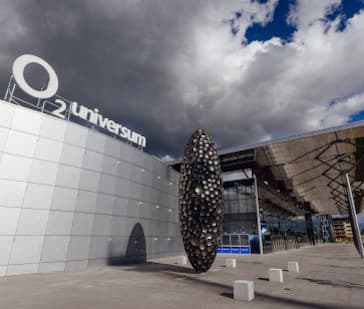
The main conference as well as the workshops will be held at O2 Universum.

We will also livestream the talks for all those participants who prefer to attend the conference online. Our platform will allow interaction with speakers and other participants too. Workshops require intensive interaction and won't be streamed.

Conference building

O2 Universum
Českomoravská 2345/17a, 190 00, Praha 9

Workshops

O2 Universum
Českomoravská 2345/17a, 190 00, Praha 9

Now or never Registration

Early Bird

Sold Out

  • Conference days € 290 + VAT
  • Only workshops € 230 + VAT
  • Conference + workshops € 490 + VAT

Standard

Late

Until sold out

  • Conference days € 350 + VAT
  • Only workshops € 290 + VAT
  • Conference + workshops € 590 + VAT

What You Get

  • Practical and advanced level talks led by top experts.
  • Networking and drinks with speakers and people from all around the world.
  • Delicious food and snacks throughout the conference.

They’re among us We are in The ML Revolution age

Machines can learn. Incredibly fast. Faster than you. They are getting smarter and smarter every single day, changing the world we’re living in, our business and our life. The artificial intelligence revolution is here. Come, learn and make this threat your biggest advantage.

Our Attendees What they say about ML Prague

Thank you to Our Partners

Strategic Partners

Platinum Partners

Gold Partners

Communities and Further support

Would you like to present your brand to 1000+ Machine Learning enthusiasts? Send us an email at info@mlprague.com to find out how to become a ML Prague 2026 partner. Our basic partnership offer can be found here.

Become a partner

Happy to help Contact

If you have any questions about Machine Learning Prague, please e-mail us at
info@mlprague.com


Organizers

Jiří Materna
Scientific program & Co-Founder
jiri@mlprague.com

Teresa Pulda
Event production
teresa@mlprague.com

Gonzalo V. Fernández
Marketing and social media
gonzalo@mlprague.com

Jona Azizaj
Partnerships
jona@mlprague.com

Ivana Javná
Speaker support
ivana@mlprague.com

Barbora Toman Hanousková
Communication
barbora@mlprague.com

Jan Romportl
Moderator